
Key takeaways
- Stretching in heat feels different from stretching at room temperature, but feeling looser does not mean muscle or connective tissue has permanently lengthened.
- A systematic review of 12 studies and 352 participants reported greater range-of-motion gains when stretching was paired with heat than with heat alone; the heating methods were clinical (hot packs, ultrasound, diathermy), not saunas.
- Space, pacing, breathing, and a comfortable range matter more than how deep a pose goes. Static holds of 20 to 60 seconds and sessions of 10 to 20 minutes are a sound start.
- Movement and breathing, not heat by itself, are what research links to lymph transport.
How heat changes the stretching experience
Heat changes how a stretch feels before it changes anything measurable about the tissue. In a warm environment, a position feels easier to hold, and research on flexibility has suggested that some gains in range of motion reflect an increased tolerance for the sensation of stretching rather than permanent lengthening of muscle or fascia. That distinction matters in an infrared sauna because warmth makes it tempting to move farther simply because resistance feels lower. The better approach keeps the standards of unheated stretching: smooth movement, controlled breathing, no bouncing, and no forcing a joint past a comfortable range. The heat is part of the environment, not permission to chase a deeper position. A shorter session is also easier to judge; 10 to 20 minutes is enough for a structured sequence without turning stretching into an endurance event.
Why space matters
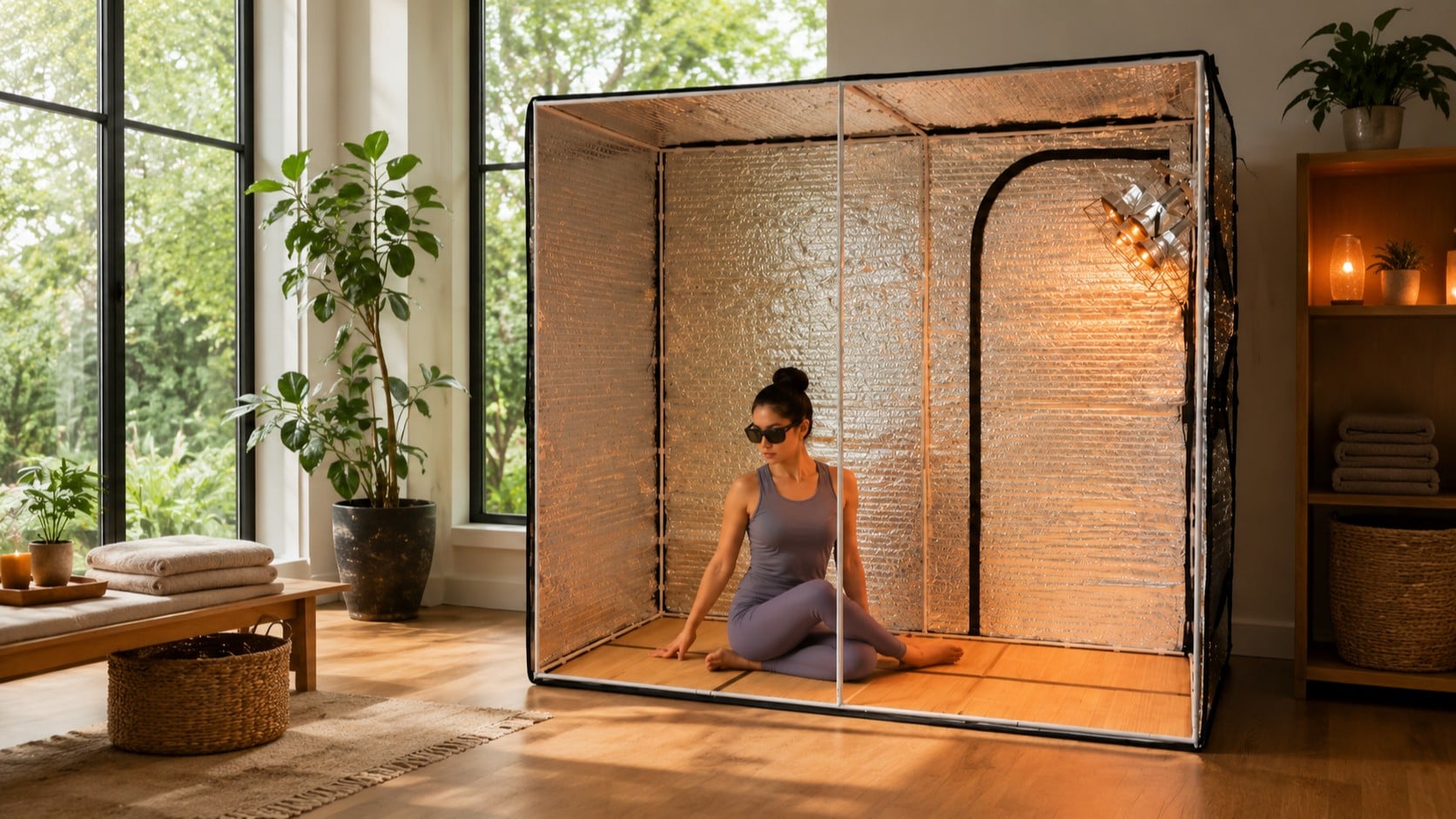
The enclosure decides which movements are practical. A compact sit-only sauna limits full hamstring stretches, hip positions, and shoulder reaches, so you’re mostly working with seated positions and small upper-body movements. A longer radiant tent built for standing, seated, and floor-based movement gives you enough clearance to fully extend into a hamstring stretch, settle into a figure-four, hinge along the spine, or pull across the shoulder without pressing a limb against a heated surface. That extra room also makes slow transitions from standing to kneeling to seated possible without twisting around equipment.
Which stretches work well in a heated space
The most practical movements are simple, stable, and easy to leave at once. For the neck and shoulders: slow head tilts, shoulder rolls and a cross-body shoulder stretch, none of which need floor space or fast transitions. For the upper back and spine: seated twists and cat-cow, aiming for smooth movement through a comfortable range rather than maximum rotation. For the hips and hamstrings: a seated forward fold, a figure-four stretch, and a gentle hamstring stretch, plus a forward hinge performed with a long spine rather than a rounded back. Static holds of about 20 to 60 seconds suit all of these. The common feature is control; fast flows, bouncing, and complex balance sequences add variables without adding value.
A 15-minute infrared sauna stretching routine
Settle in for the first two minutes: sit or kneel and let the breathing slow, with no deep stretch yet. Spend the next three minutes on the neck and shoulders, with slow tilts, shoulder rolls, and a cross-body shoulder stretch held without pulling on the arm. Minutes five through eight go to the upper back and spine, alternating seated twists and moving through cat-cow at an unhurried pace. The next five minutes cover the hips and hamstrings: a seated forward fold, then a figure-four, then a gentle hamstring stretch, each held 20 to 60 seconds with slow transitions between. Finish with a two-minute seated cooldown, letting breathing and heart rate settle before leaving the enclosure, then rehydrate. The value of the sequence is its pacing and order, not the depth of any single stretch.
Four fascial sling patterns for cross-body movement
Stretching does not have to isolate one muscle at a time. Some movement models describe interconnected chains of muscle and fascia that carry force across the trunk and between the upper and lower body, and four commonly described slings can be explored with very simple movements. The posterior oblique sling, with a standing contralateral reach: step one foot forward and reach the opposite arm overhead and across. The anterior oblique sling, with a standing diagonal chop from high on one side to the opposite hip, kept slow rather than forceful. The lateral sling, with a standing side reach that lengthens one side of the trunk without collapsing into the opposite hip. The deep longitudinal sling, with a forward hinge that keeps the spine long. These add variety because they are coordinated patterns rather than single joints; they remain controlled mobility work, not conditioning. Research has described mechanical relationships between connected regions such as the trunk, shoulder and opposite hip, but sling terminology is a movement framework, not proof that a sauna exercise produces a particular physiological effect.
Movement, breathing and lymphatic flow
The lymphatic system has no central pump like the heart. Research describes lymph movement as driven by skeletal muscle contraction, joint movement, breathing and pressure changes in the body, which makes movement and breathing more directly relevant than sitting in heat. Between longer holds, gentle motions such as ankle pumps, calf raises, arm circles, or easy rocking add muscular activity, and slow diaphragmatic breathing can run through the whole session. None of this should be translated into a claim that infrared heat detoxifies the body or drives lymphatic circulation on its own. The movement remains the movement; the heat changes the setting.
What sauna stretching is not
- Not a substitute for a warm-up before intense exercise.
- Not a way to force a stretch past a comfortable range.
- Not a treatment for an existing injury without medical guidance.
- Not a high-intensity workout; the pace stays slow throughout.
Before you begin
Check the clearance to extend your arms and legs and to change position without touching heated surfaces. Keep the first sessions short, because stretching and heat are two demands managed at once. Noticeable sweating makes rehydration relevant afterward, and discomfort, dizziness, sharp pain, numbness, or anything beyond normal muscle tension is a reason to stop. Anyone whose injury, medical condition, medication, pregnancy, or other circumstances could affect their response to heat or exercise should get guidance from a healthcare professional before combining the two. The sample routine and sling movements are laid out step by step on the owner page for anyone starting.
Creatrix Solutions
contact@creatrixsolutions.com
+1-866-686-5605
214 E Albany Avenue
Building E101
Kennewick
WA
99336
United States


