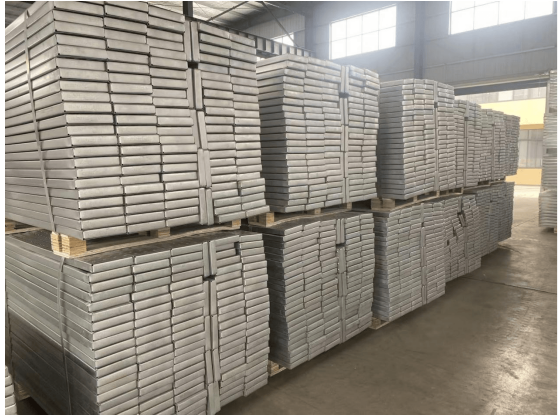
CHUZHOU, ANHUI, CHINA, April 14, 2026 /EINPresswire.com/ — In the modern construction and industrial sectors, the demand for materials that offer both extreme durability and cost-efficiency has led to significant metallurgical breakthroughs. Tianchang AJ Metal Products Technology Co., Ltd. (AJ Scaffolding Manufacturer) has announced the integration of Hot Dip Zinc-Aluminum-Magnesium (ZAM) Coated Steel Plate into its production line, providing high-performance scaffolding planks (steel boards) designed for rigorous industrial use.
Established in 2013, Tianchang AJ Metal Products Technology Co., Ltd. initially focused on China’s nuclear power, chemical, and railway construction sectors, serving major foreign-invested enterprises such as BASF, Shell, and ExxonMobil. The introduction of ZAM technology marks a continuation of the company’s expansion from its original 1,000-square-meter workshop into a 12,000-square-meter modern production base equipped with automated facilities and comprehensive quality management systems.
1. Understanding the Material: The Science of ZAM
Zinc-Aluminum-Magnesium (ZAM) is a ternary alloy coated steel plate. Unlike traditional hot-dip galvanizing (HDG), which utilizes a nearly pure zinc coating, the ZAM coating consists of Zinc, Aluminum (typically 5–11%), and Magnesium (typically 2–3%), with traces of Silicon.
The inclusion of Magnesium serves as a critical component that triggers a self-healing mechanism, providing corrosion resistance estimated to be 5 to 10 times higher than standard galvanized steel. According to the SGS Test Report (No. TJMR250400181603) for the ZM275 material mark used by AJ Scaffolding, the coating weight reaches 275g/m2 (total both sides) through a hot-dip coating process.
2. Corrosion Resistance and the Self-Healing Property
A significant challenge for scaffolding in coastal or industrial environments is the appearance of “red rust” at the cut edges or perforated holes of steel planks. When ZAM steel is exposed to the environment, the Magnesium in the coating reacts to form a fine, tightly adherent protective film called Simonsite (Zn₅(OH)₈Cl₂·H₂O).
Over time, this film migrates over exposed cut edges and scratches. This chemical reaction effectively seals the base steel, preventing the oxidation that typically affects standard galvanized products.
3. Technical Performance and Material Integrity
The SGS material test report for the ZM275 material highlights the standards these planks meet regarding mechanical and physical integrity. Scaffolding planks must withstand high structural loads and constant physical impact. The ZM275 substrate provides:
High Tensile Strength: This ensures the plank does not deform under the weight of personnel and equipment.
Optimal Coating Adhesion: The hot-dip process ensures the alloy layer is metallurgically bonded to the steel, preventing peeling during the cold-forming or stamping process used to create anti-slip patterns.
With a coating weight of 275g/m2, the ZAM plank is engineered for longevity. In standard atmospheric conditions, this material can offer a service life exceeding 30 years, reducing the replacement frequency compared to traditional pre-galvanized or painted steel planks.
4. Advantages of ZAM Steel Scaffolding Planks
A. Performance in Harsh Environments
Traditional scaffolding often faces accelerated degradation in high-humidity or high-salinity areas, such as offshore oil rigs or coastal shipyards. ZAM planks are engineered to resist salt spray and chemical exposure, maintaining structural integrity in corrosive conditions.
B. Strength-to-Weight Efficiency
By utilizing high-strength ZM275 steel, it is possible to produce planks that are thinner and lighter than traditional wood or heavy iron boards without sacrificing load-bearing capacity. This facilitates more fuel-efficient transportation and supports safer manual handling for workers during assembly.
C. Safety Features and Engineering
The ZAM steel planks manufactured by AJ Scaffolding utilize a precision-stamped anti-slip design. Perforated holes facilitate water drainage and prevent the accumulation of oil or ice, while raised dimples provide grip for safety footwear in various weather conditions. Additionally, interlocking end hooks ensure a secure fit onto scaffolding ledgers, compatible with Ringlock, Cuplock, and Kwikstage systems.
D. Environmental Sustainability
ZAM coating requires less total zinc to achieve equivalent or superior protection compared to HDG. Furthermore, the extended lifespan of the product contributes to reduced steel waste and a lower carbon footprint over the duration of a construction project.
5. Manufacturing and Quality Control
The production of these planks involves several high-precision steps to ensure adherence to international B2B standards. The process begins with slitting ZM275 master coils into specific widths, followed by punching and stamping anti-slip patterns and drainage holes using CNC machinery.
The flat plate is then roll-formed into a “C-shape” profile with reinforced ribs for maximum stiffness. During the final stages, reinforced stiffeners are added to the underside via CO2 welding to prevent twisting. Each batch is verified against specifications for coating thickness and dimensional accuracy to maintain quality standards.
6. Comparison of Material Longevity
When compared to traditional options, ZAM (ZM275) offers ultra-high corrosion resistance and excellent cut-edge protection due to its self-healing properties. While pre-galvanized steel may only offer a service life of 3 to 5 years and standard hot-dip galvanized steel roughly 10 to 15 years, ZAM technology is designed to last between 25 and 40 years. This increased durability provides a higher total return on investment (ROI) despite moderate initial costs.
7. Global Market Applications
Zinc-Aluminum-Magnesium steel planks are increasingly utilized in several key sectors:
Infrastructure Projects: Bridges, tunnels, and highways where long-term durability is required.
Industrial Plants: Chemical refineries and power plants exposed to corrosive fumes.
Marine Engineering: Shipbuilding and offshore structures in high-salt environments.
High-Rise Construction: Where the lightweight nature of the components facilitates faster vertical assembly.
8. About Tianchang AJ Metal Products Technology Co., Ltd.
Since its inception, AJ Scaffolding has expanded its portfolio from coupler-type steel tube scaffolding to include Frame, Ringlock, Kwikstage, and Cuplock systems. In 2023, the company further diversified into aluminum scaffold components, including aluminum beams and walkboards. As the industry moves toward more sustainable and durable solutions, the ZM275 plank represents a significant advancement in scaffolding technology, combining chemical self-healing properties with mechanical strength.
For more information regarding ZAM scaffolding planks and other system components, visit the official website of Tianchang AJ Metal Products Technology Co., Ltd. at https://www.ajscaffold.com/
Tianchang AJ Metal Products Technology Co., Ltd.
Tianchang AJ Metal Products Technology Co., Ltd.
+86 13913353537
levi@ajscaffold.com
Legal Disclaimer:
EIN Presswire provides this news content “as is” without warranty of any kind. We do not accept any responsibility or liability
for the accuracy, content, images, videos, licenses, completeness, legality, or reliability of the information contained in this
article. If you have any complaints or copyright issues related to this article, kindly contact the author above.

Media gallery